
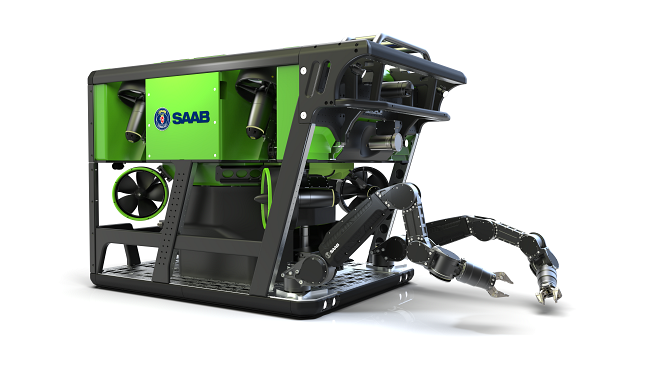
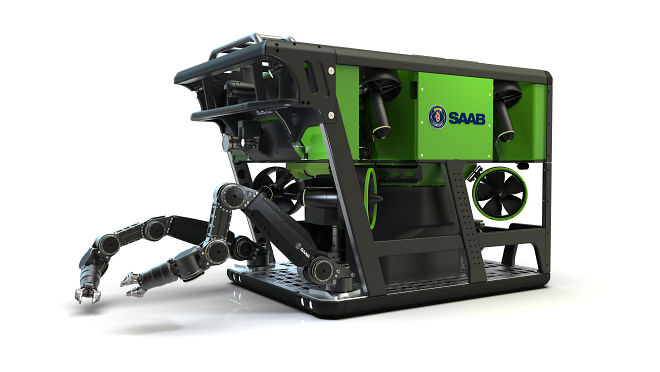
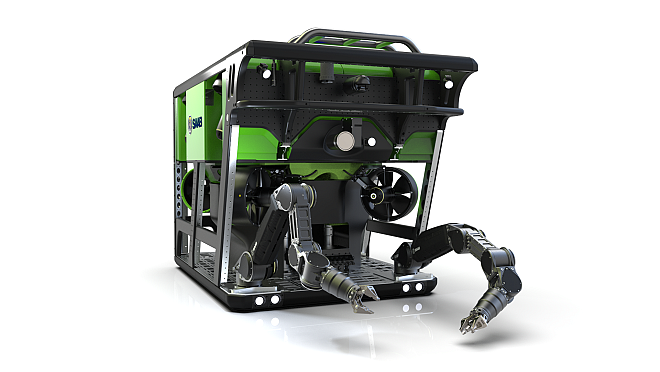
Description
-
State-of-the-art DC power transmission systems enable significantly smaller and lighter units compared to high-voltage AC power transmissions. These systems also support the use of smaller-diameter umbilicals, including those already owned by clients.
-
Electric thrusters are central to the electrification of the work ROVs; capable of generating 580 kgf, the SR20’s power efficiency far exceeds that of hydraulic systems, delivering superior acceleration, braking, and reversal performance.
-
Electric manipulators play a pivotal role in the electrification ethos of the work ROVs. They provide significant advantages over hydraulic alternatives, including more precise positioning, enhanced dexterity, reduced in-water weight, and improved reliability—key for autonomous and resident applications. Featuring an advanced control system with an open interface, work ROV manipulators support both manual and automated operations. Highly accurate, modular electric joints enhance arm control, enable advanced path planning solutions, and allow actuator re-use.
-
In its standard configuration, the SR20 offers approximately 1,350 litres of available payload volume, which increases to 1,550 litres when the hydraulics module and valve pack are removed.
-
SR20 features an extremely rugged chassis constructed from polymer, aluminium, and stainless steel, designed to maximise water flow through the ROV. Materials and design are optimised to achieve a lightweight yet robust chassis that provides excellent strength and stiffness. The chassis includes rigid mountings for skids, tools, and sensors, and is engineered for repeated and prolonged submergence in marine environments, offering exceptional corrosion resistance throughout its design life.
-
The SR20 introduces new standards of reliability and low maintenance, combined with high levels of automation and autonomy. These advancements enable deployment from smaller, minimally crewed vessels, further reducing the CO₂ footprint and improving health and safety risks.
-
The distributed hardware and software principles at the core of the SR20 were pioneered by Saab. This Ethernet-based architecture forms an intelligent network of configurable hardware and software modules, delivering advanced underwater robotic solutions. The modular system provides real-time control and feedback across every subsystem, making the SR20 ideally suited for increasingly remote and autonomous operations. The comprehensive common technology ecosystem simplifies operation, training, and maintenance, while the expandable, future-proof architecture ensures long-term adaptability.
-
The SR20’s Ethernet architecture is specifically designed for low-latency IP camera operation. Its video routing system uses cameras configured to send multicast Ethernet traffic via managed layer 3 switches. This approach allows multiple receiving devices to subscribe to video streams without duplicating traffic or requiring additional hardware. By minimising elements in the video system, the multicast approach enhances flexibility in video distribution. Precision Time Protocol (PTP) synchronises devices within the video system, achieving nanosecond accuracy while compensating for network latency and jitter. This feature is particularly beneficial for remote, onshore operators managing video and telemetry data.
-
SR20 is available as a free-swimming ROV or with a Top-Hat Tether Management System (TMS).